

Introduction
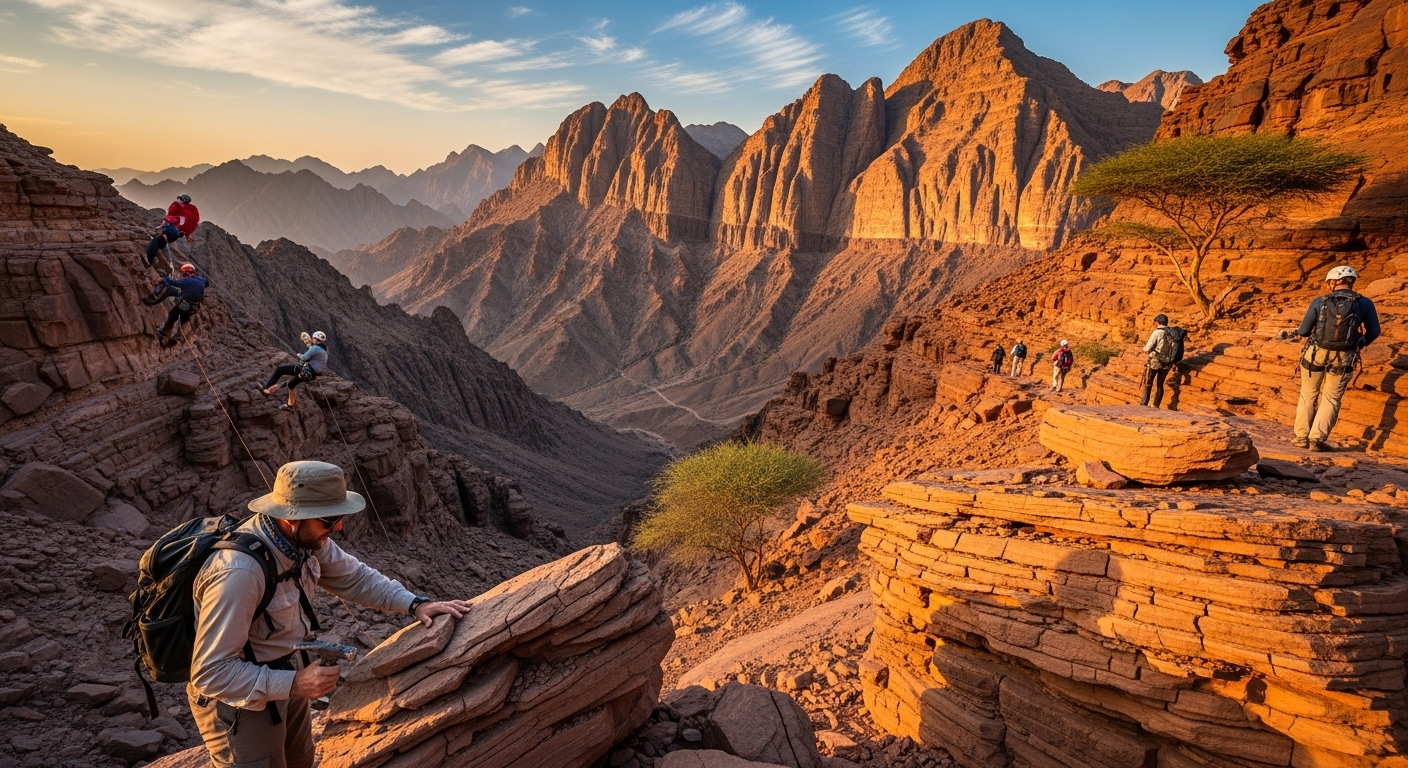
Bisecting the eastern UAE and stretching into Oman, the Hajar Mountains present a dramatic counterpoint to the nation’s iconic desert dunes. These rugged, rocky highlands are not merely a scenic backdrop; they are a geologist’s open-air museum, an ancient fortress that has shaped human settlement for millennia, and an emerging playground for adventurers. From their formation in the deep past to their role as a source of water and minerals, the Hajar Mountains are a foundational pillar of the UAE’s diverse geography.
The Birth of a Range: A Collision of Continents
The story of the Hajar Mountains begins over 90 million years ago, during the late Cretaceous period. They are the result of a massive tectonic collision, as the Arabian plate was forced under the Eurasian plate. This immense pressure caused the ocean floor of the Tethys Sea to be thrust upward, creating the range. This origin is why the mountains are composed primarily of oceanic rock—dark, volcanic basalt and the lighter-colored limestone and dolomite that were once ancient coral reefs. Fossils of marine creatures embedded in the rock provide silent testimony to this dramatic geological past.
Jebel Jais and Jebel Hafeet: The Titans of the UAE
The two most prominent peaks in the UAE are Jebel Jais in Ras Al Khaimah and Jebel Hafeet in Al Ain. Jebel Jais, part of the larger Hajar range, is the highest peak in the country, reaching 1,934 meters (6,345 feet). Its barren, jagged peaks and deep canyons, known as wadis, create a stark, majestic landscape. Jebel Hafeet, standing at 1,249 meters (4,098 feet), is a solitary limestone mountain that rises abruptly from the flat surrounding plains. It is a “anticlinal” mountain, meaning it was formed by the folding of rock layers, and it stands as a sentinel overlooking the Al Ain oasis.
The Role of Wadis: Carving Life from Stone
The Hajar Mountains are crisscrossed by wadis—dry river valleys that channel rare but torrential rainfall from the mountains to the plains. These wadis are the arteries of life in an otherwise arid region. They contain seasonal pools of water and have allowed for the development of unique ecosystems. Wadis like Wadi Wurayah in Fujairah and Wadi Al Bih in Ras Al Khaimah are renowned for their biodiversity, including rare Arabian leopards, the Arabian tahr, and countless species of birds and plants. For humans, wadis have historically provided routes for travel and, critically, the alluvial fans at their mouths are where agriculture has long been possible.
A History of Human Habitation and Industry
The mountains have never been a barrier; they have been a resource. Their caves and cliffs provided shelter for early humans, as evidenced by archaeological finds and rock art. The mountains were a vital source of copper, which was mined and smelted as far back as the Bronze Age Umm an-Nar culture (c. 2500 BCE). Later, the mountains provided stone for building forts and homes, and their strategic high points were chosen for watchtowers and fortifications, controlling the trade and travel routes through the valleys.
Conclusion: More Than a Backdrop
The Hajar Mountains are an active and essential component of the UAE’s geography and history. They are not a passive scenic view but a dynamic force that has dictated settlement patterns, provided vital resources, and captured precious rainfall. Today, they offer a different dimension of Emirati life—one of hiking, rock climbing, and eco-tourism. From their tumultuous birth millions of years ago to their modern role as a destination for adventure, the Hajar Mountains stand as a powerful, enduring reminder of the raw, diverse, and magnificent natural forces that have shaped the United Arab Emirates.